Container Straddle Carrier Crane
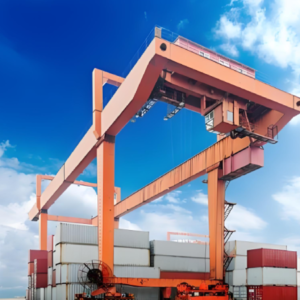
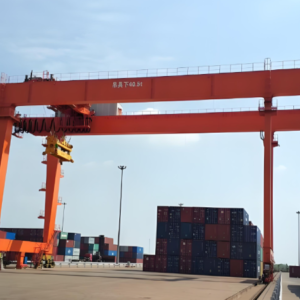
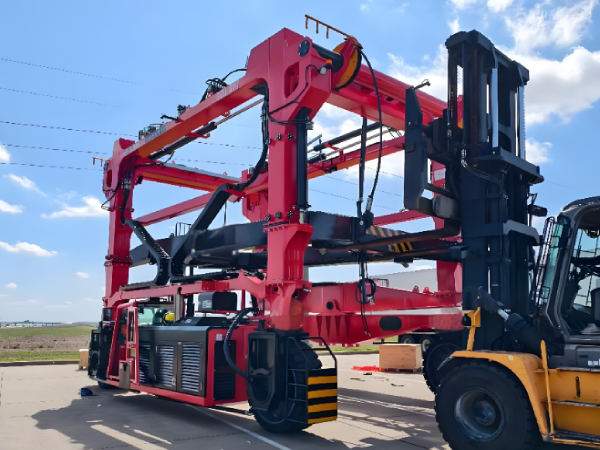
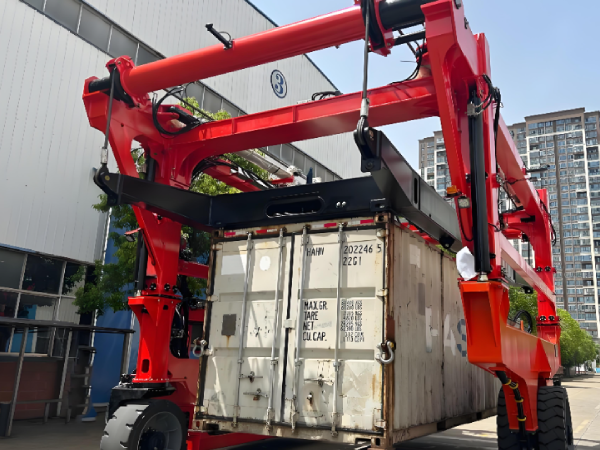
The Container Straddle Carrier Crane is a self-propelled, rubber-tyred vehicle engineered to hoist, transport, and stack standard shipping containers within terminal yards, offering exceptional versatility and independent mobility.
Description
The Container Straddle Carrier Crane is a heavy-duty, rubber-tyred gantry crane designed for the efficient stacking and transport of intermodal containers. Its design prioritizes maneuverability, lifting capacity, and operational safety.
1. Robust Lifting Capacity & Stacking Height
- Heavy-Duty Performance: Engineered to handle standard 20ft, 40ft, and 45ft containers, with a typical lifting capacity ranging from 40 to 65 tons (including laden containers).
- High Stacking Capability: Advanced models can stack containers up to 3 to 4 units high and 6+1 wide, maximizing the storage density of the terminal yard without the need for massive fixed infrastructure.
2. Advanced Maneuverability & Mobility
- All-Wheel Steering: Equipped with independent steering systems (capable of 90-degree turns and crab steering), allowing the Container Straddle Carrier Crane to navigate tight spaces and congested yards with a minimal turning radius.
- Rubber Tyred Mobility: Unlike rail-mounted gantry cranes, it operates on heavy-duty rubber tires, providing the flexibility to move anywhere within the terminal yard without track constraints.
3. State-of-the-Art Control & Safety Systems
- Anti-Sway Technology: Features intelligent hydraulic or electric control systems that minimize load sway during movement, ensuring precise positioning and reducing cycle times.
- Automated Positioning (GPS/GNSS): Modern units integrate GPS or DGPS for automatic container positioning, guiding the spreader directly to the target slot with high accuracy.
- 360-Degree Visibility: The operator cabin is elevated and designed with panoramic windows, often augmented by CCTV cameras and proximity sensors to eliminate blind spots.
4. Efficient Power & Energy Recovery
- Dual Power Options: Available in both diesel-electric and fully electric (battery or cable reel) configurations to meet different emission standards.
- Regenerative Braking: The system captures kinetic energy during lowering and braking, converting it back into electrical energy to recharge the batteries or assist the engine, significantly reducing fuel consumption.
Maintenance of Container Straddle Carrier Crane
To ensure the longevity and uptime of a Container Straddle Carrier Crane, a rigorous maintenance schedule is essential. The maintenance focuses on the powertrain, structural integrity, and hydraulic systems.
1. Tires and Chassis Maintenance
- Tire Inspection: Given the heavy loads, tires are the most critical wear component. Regularly check for uneven wear, cuts, or embedded debris. Rotate tires per the manufacturer’s schedule to ensure even lifespan.
- Steering Linkage: Inspect kingpins, steering cylinders, and linkages for play or hydraulic leaks. Ensure the steering alignment is calibrated to prevent tire scrubbing.
2. Engine and Powertrain Care
- Fluid Management: Regularly change engine oil, hydraulic fluid, and coolant. Check for leaks in the fuel and hydraulic lines, which are common in high-vibration environments.
- Filter Replacement: Air filters must be cleaned or replaced frequently, especially in dusty port environments, to prevent engine damage from particulate matter.
- Braking System: Inspect service brakes and parking brakes. For hydraulic retarders, check the oil level and heat dissipation.
3. Structural and Spreader Maintenance
- Spreader Calibration: The container spreader (the part that locks onto the container) requires weekly checks. Test the twist locks for smooth operation and ensure the anti-lift pins are functioning to prevent accidental drops.
- Structural Inspections: Perform monthly visual checks on the main gantry legs and boom for cracks, corrosion, or weld fatigue. Pay special attention to high-stress areas.
4. Electrical and Hydraulic Systems
- Cabling and Connections: Inspect electrical cables for abrasion, particularly those moving with the spreader. Tighten terminal connections to prevent voltage drops and arcing.
- Hydraulic Pressure Testing: Regularly test the hydraulic system pressure to ensure it matches operational specifications. Check hoses for bulges or brittleness that could lead to failure.
5. Preventive Software Updates
- System Diagnostics: Utilize the crane’s on-board diagnostic system to monitor error codes. Keep the PLC (Programmable Logic Controller) and drive control software updated to optimize performance and safety features.
Additional information
| Lifting Capacity | 20–60 tons |
|---|---|
| Lifting Height (Stacking Level) | 1–3 containers |
| Travel Speed | 20–45 km/h |